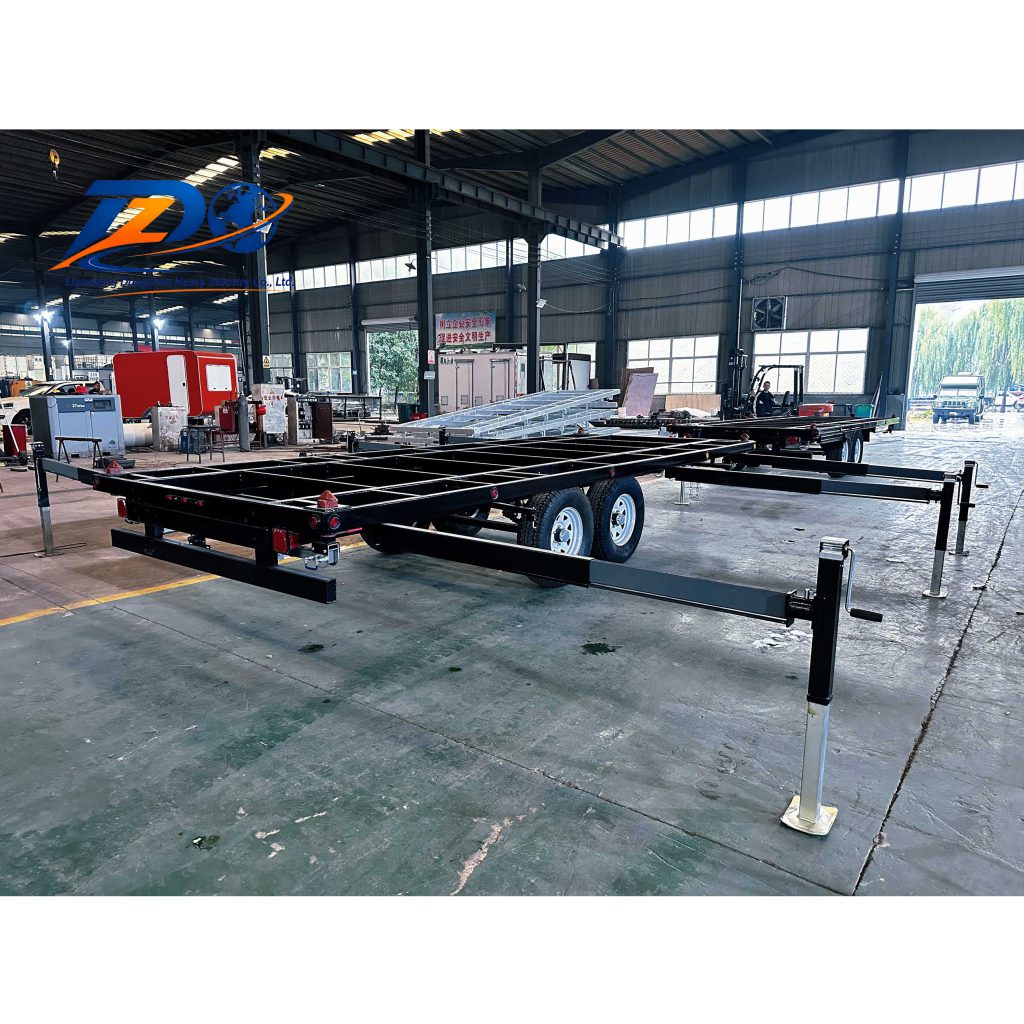
How to Choose a Tiny House Trailer Chassis in Australia: A Complete Buyer’s Guide
Choosing the right tiny house trailer chassis is one of the most important decisions when planning a tiny house project in Australia.
A suitable chassis provides the structural foundation for the entire building. It needs to support the finished house, furniture, appliances, water systems and other equipment while meeting the relevant engineering and road transport requirements.
Whether you are an individual building your own tiny house, an Australian tiny house builder, or a trailer dealer looking for a reliable manufacturing partner, understanding the key specifications before purchasing a trailer chassis can help you avoid costly mistakes.
In this guide, DZ Heavy explains the six key factors to consider when choosing a tiny house trailer chassis for the Australian market.
1. Determine the Required Tiny House Dimensions
Before selecting a trailer chassis, you should confirm the overall dimensions and design of your tiny house.
The chassis must be designed to suit the house structure rather than selecting a trailer first and trying to fit the house afterwards.
Common Tiny House Trailer Sizes
Some commonly requested tiny house trailer lengths include:
| Trailer Size | Approximate Length | Typical Application |
|---|---|---|
| 20FT | 6.1 metres | Compact tiny houses |
| 24FT | 7.3 metres | Small residential projects |
| 30FT | 9.1 metres | Medium-sized tiny houses |
| 32FT | 9.8 metres | Larger residential layouts |
| 40FT | 12.2 metres | Large tiny houses and commercial projects |
These are nominal size references. Actual chassis dimensions should be confirmed with the manufacturer.
What Dimensions Should You Confirm?
Before requesting a quotation, prepare the following information:
- Overall house length
- Overall house width
- Finished house height
- Chassis length and width
- Drawbar length
- Wheel and mudguard clearance
- Door and stair access requirements
- Position of plumbing and electrical installations
Pay particular attention to the total trailer dimensions.
In Australia, the overall trailer length includes the drawbar, coupling and relevant rear projections. Overall width also needs to account for the applicable measurement rules.
For road transport, the standard maximum vehicle width is generally 2.5 metres, subject to applicable exceptions and requirements. Always check the relevant vehicle standards before finalising your design.
DZ Heavy Tip: Provide your house floor plan or technical drawing to your trailer manufacturer before production. This allows the chassis structure, cross-members and mounting positions to be designed around the actual house requirements.
2. Choose Between Single Axle, Tandem Axle and Tri-Axle Trailers
The axle configuration is another important consideration when selecting a tiny house trailer chassis.
Different axle configurations provide different load capacities, structural arrangements and handling characteristics.
Single Axle Trailer
A single axle trailer has one axle and is generally used for smaller and lighter trailer applications.
Advantages:
- Simpler overall configuration
- Fewer axle and suspension components
- Lower component count
Considerations:
- Limited load capacity compared with many multi-axle designs
- Requires careful assessment of axle, tyre and load ratings
- May not be suitable for larger or heavier tiny houses
Single axle configurations are generally more suitable for smaller projects where the engineering requirements allow them.
Tandem Axle Trailer
A tandem axle trailer uses two axles and is a common configuration for medium-sized trailer applications.
Advantages:
- Load distributed across two axles
- Suitable for many medium-sized tiny house projects
- Practical balance between structural capacity and overall design
Considerations:
- Axle ratings must be correctly matched to the intended load
- Suspension geometry and braking performance need to be properly engineered
- The finished house weight must remain within the approved trailer ratings
Tri-Axle Trailer
A tri-axle trailer uses three axles and is often considered for larger or heavier tiny house projects.
Advantages:
- Load distribution across three axles
- More flexibility in designing higher-capacity chassis configurations
- Suitable for certain longer and heavier tiny house applications
Considerations:
- Higher component and maintenance requirements
- More complex suspension and braking arrangements
- Additional attention to turning characteristics and axle load distribution
Which Axle Configuration Should You Choose?
| Configuration | Typical Application |
|---|---|
| Single Axle | Smaller and lighter projects |
| Tandem Axle | Medium-sized tiny houses |
| Tri-Axle | Larger or heavier tiny houses |
The number of axles alone does not determine the legal load capacity of a trailer.
The final design must consider chassis strength, axle ratings, suspension, tyres, brakes, coupling capacity and applicable Australian vehicle standards.
3. Understand ATM, GTM and Tare Mass
If you are purchasing a tiny house trailer in Australia, understanding three important weight specifications is essential:
- ATM – Aggregate Trailer Mass
- GTM – Gross Trailer Mass
- Tare Mass
These specifications determine how much weight the trailer is designed to carry and how its load is distributed.
What Is ATM?
ATM stands for Aggregate Trailer Mass.
It is the maximum total mass of the trailer when fully loaded, including the mass imposed on the towing vehicle through the coupling when the trailer is uncoupled and resting on a horizontal surface.
For example:
If a tiny house trailer has an ATM rating of 4,500 kg, the combined mass of the trailer, house and load must not exceed 4,500 kg.
What Is GTM?
GTM stands for Gross Trailer Mass.
It is the maximum mass transmitted through the trailer’s tyres to the ground when the trailer is coupled to the towing vehicle and carrying its maximum recommended load.
The difference between ATM and GTM represents the coupling load under the specified loading conditions.
What Is Tare Mass?
Tare Mass is the mass of the trailer when it is unladen and ready for service, including its standard equipment and fitted options.
For a tiny house trailer, the tare mass is particularly important because it determines how much capacity remains for the house and its contents.
Example: Calculating Available Payload
Consider the following example:
| Specification | Weight |
|---|---|
| Trailer ATM | 4,500 kg |
| Trailer Tare Mass | 1,200 kg |
| Available Payload | 3,300 kg |
Calculation:
Available Payload = ATM − Tare Mass
4,500 kg − 1,200 kg = 3,300 kg
This means the remaining payload allowance is 3,300 kg.
The allowance must cover the house structure, interior fit-out, appliances, plumbing equipment, water, furniture and other additional items.
Always use the actual tare mass of the finished trailer rather than relying only on an estimated factory weight.
Important: Understanding Australian Trailer Categories
Australian trailer categories are determined by Gross Trailer Mass (GTM), not simply by the number of axles or the ATM rating.
Under Vehicle Standards Bulletin 1 (VSB 1):
- TA – Very Light Trailer: Single axle, GTM not exceeding 750 kg.
- TB – Light Trailer: GTM not exceeding 3,500 kg, excluding TA.
- TC – Medium Trailer: GTM exceeding 3,500 kg but not exceeding 10,000 kg.
A trailer with an ATM of 4,500 kg does not automatically fall into the TB category.
For example, a trailer with an ATM of 4,500 kg and a GTM of 3,950 kg falls within the TC mass category based on its GTM.
This distinction is important when discussing trailer specifications, compliance and registration requirements with Australian authorities.
4. Select the Right Braking System and Suspension
The braking system and suspension are essential safety components of a tiny house trailer chassis.
They should be selected according to the trailer’s rated mass, axle configuration and intended application.
Trailer Braking Systems
Common trailer braking configurations include:
Electric Brakes
Electric brakes are commonly used on medium and heavier trailer applications.
They are controlled through a compatible brake controller in the towing vehicle, allowing the driver to adjust braking force.
Electric-Hydraulic Brakes
Electric-hydraulic systems use an electrically controlled hydraulic actuator to operate hydraulic brakes.
They may be considered for applications requiring a suitable hydraulic braking arrangement, subject to the relevant approval and compatibility requirements.
Breakaway System
A breakaway system is designed to activate the trailer brakes if the trailer becomes disconnected from the towing vehicle.
For applicable heavier low-ATM trailer configurations, a compliant breakaway system is required.
For example, under the relevant low-ATM requirements, trailers with a GTM between 2,001 kg and 4,500 kg must have brakes operating on all wheels of all axles, an appropriate non-overrun braking system and a compliant breakaway system.
The exact requirements must be checked against the applicable ADRs and current VSB 1.
Trailer Suspension Options
Common suspension arrangements include:
- Leaf Spring Suspension
- Independent Suspension
- Other engineered suspension configurations suitable for the application
When selecting suspension, consider:
- Rated load capacity
- Axle load distribution
- Road conditions
- Expected operating environment
- Maintenance requirements
- Compatibility with the braking system
The suspension, axles, wheels and tyres must be engineered as a complete system rather than selected independently.
5. Check Australian Compliance Before Importing a Trailer
This is one of the most important considerations when purchasing a tiny house trailer chassis from an overseas manufacturer.
A trailer designed for another market is not automatically compliant with Australian road vehicle requirements.
Australian road vehicle standards include the Australian Design Rules (ADRs), while the Road Vehicle Standards Act 2018 (RVSA) establishes the national approval framework.
What Should You Check?
Before placing an order, discuss the following items with your manufacturer and Australian compliance consultant:
1. Trailer Dimensions
Confirm the overall length, width, height, ground clearance and other relevant dimensional requirements.
2. Braking System
Check that the braking system meets the applicable ADR 38 requirements for the trailer’s rated mass and configuration.
3. Lighting and Reflectors
Confirm that the required lamps, reflectors and electrical installations meet the applicable Australian requirements.
4. Coupling and Safety Chains
Check the coupling rating, drawbar design and safety chain attachment requirements.
5. Axles, Suspension and Tyres
Verify that the axle, suspension, wheel and tyre specifications are suitable for the intended trailer ratings.
6. VIN and Vehicle Identification Plate
Confirm the requirements for the Vehicle Identification Number (VIN), vehicle plate and relevant vehicle information.
7. Approval and RAV Entry
For trailers supplied to the Australian market, determine the applicable approval pathway under the RVSA and whether the vehicle must be entered on the Register of Approved Vehicles (RAV).
For commercial supply of low-ATM trailers, the manufacturer or importer should investigate the appropriate Vehicle Type Approval (VTA) pathway where required.
A concessional RAV entry approval is generally limited to four low-ATM trailers in a 12-month period and should not be assumed to be suitable for ongoing commercial production and supply.
Important Note for Australian Buyers
A manufacturer’s statement that a trailer is designed for the Australian market does not, by itself, establish that the finished vehicle has received the required Australian approval.
Before importing, ask your supplier to provide supporting technical documentation and confirm the approval responsibilities with the relevant Australian approval holder or compliance specialist.
6. What Documents Should You Request from a Chinese Trailer Manufacturer?
When sourcing a tiny house trailer chassis from China, do not compare suppliers based on price alone.
A professional manufacturer should be able to explain its product specifications, manufacturing processes and quality control arrangements.
We recommend requesting the following information before confirming an order.
| Document / Information | Why It Matters |
|---|---|
| Product Technical Specification | Confirms dimensions and configurations |
| Chassis Engineering Drawings | Shows structural layout and key dimensions |
| Axle and Suspension Specifications | Helps verify component ratings |
| Brake System Details | Confirms the braking configuration |
| Coupling and Safety Chain Details | Supports compliance assessment |
| Material Specifications | Identifies the steel grades and components used |
| Tare Mass Information | Helps calculate available payload |
| Manufacturing Photos and Videos | Demonstrates actual factory production |
| Quality Inspection Records | Provides evidence of manufacturing checks |
| Applicable Component Approval Evidence | Supports the compliance assessment |
For Australian projects, the technical documentation should be reviewed against the actual vehicle design and relevant approval requirements.
A good manufacturer should also be willing to discuss engineering changes, custom dimensions and production requirements before manufacturing begins.
7. How to Request a Quotation from a Tiny House Trailer Manufacturer
To receive an accurate quotation, prepare as much technical information as possible.
A complete enquiry helps the manufacturer understand your project and recommend a suitable chassis configuration.
Information to Include in Your Enquiry
Basic Project Information
- Required trailer size: 20FT, 30FT or 40FT
- Overall chassis length and width
- Intended house dimensions
- Expected finished house weight
Technical Requirements
- Required ATM and GTM
- Single, tandem or tri-axle configuration
- Preferred braking system
- Suspension requirements
- Coupling specifications
- Required accessories
Commercial Requirements
- Order quantity
- Delivery destination in Australia
- Preferred delivery port
- Required delivery schedule
- Whether you need chassis-only supply or additional equipment
Example Enquiry to a Manufacturer
You can use the following format when contacting a trailer manufacturer:
“Hello,
We are looking for a manufacturer of Tiny House Trailer chassis for the Australian market.
Our initial requirements are:
- Trailer Size: 20FT
- Required ATM: 4,500 kg
- Required GTM: To be confirmed through engineering
- Axle Configuration: Tri-Axle
- Braking System: Electric Brakes
- Supply Scope: Chassis Only
- Quantity: 10 Units
- Destination: Australia
Could you please provide your product specifications, engineering drawings, factory quotation and available technical documentation?
We would also like to understand your manufacturing capabilities and experience supplying trailers for the Australian market.
Thank you.”
8. Why Work with DZ Heavy as Your Tiny House Trailer Chassis Manufacturer?
Shandong Dongzhen Heavy Industry Co., Ltd. is a professional trailer manufacturer based in Liaocheng, Shandong, China.
We specialise in trailer manufacturing and customised chassis solutions for international customers.
Our product range includes:
- Tiny House Trailer Chassis
- Tandem Axle Trailers
- Tri-Axle Trailers
- Flatbed Trailers
- Car Trailers
- Hydraulic Tipping Trailers
- Horse Floats
- Boat and Jet Ski Trailers
Our Manufacturing Capabilities
Custom Manufacturing
We can discuss different chassis lengths, widths, axle configurations and structural arrangements according to project requirements.
Factory-Direct Supply
Working directly with the manufacturer allows customers to communicate with the production team and discuss technical requirements.
OEM Solutions
We welcome enquiries from trailer dealers, distributors and tiny house builders looking for customised manufacturing and long-term supply partnerships.
International Business
We are interested in building long-term relationships with Australian trailer dealers, distributors and tiny house manufacturers.
Our goal is to provide reliable manufacturing solutions and support customers throughout the product specification and ordering process.
9. Frequently Asked Questions (FAQs)
Q1: What is the best trailer size for a tiny house in Australia?
The best size depends on the intended house layout, finished weight, transport requirements and applicable road regulations. Common nominal sizes include 20FT, 30FT and 40FT.
Q2: Is a tri-axle trailer better than a tandem axle trailer?
Not necessarily. A tri-axle configuration can provide additional flexibility for certain heavier applications, while tandem axle designs may be suitable for many medium-sized projects. The correct choice depends on engineering calculations and component ratings.
Q3: What is the difference between ATM and GTM?
ATM includes the total mass supported by both the trailer tyres and the towing vehicle coupling when the trailer is uncoupled. GTM is the mass transmitted through the trailer tyres when it is coupled to the towing vehicle.
Q4: How much payload can a tiny house trailer carry?
The available payload is generally calculated as ATM minus Tare Mass.
For example, a trailer with an ATM of 4,500 kg and a Tare Mass of 1,200 kg has a theoretical payload allowance of 3,300 kg.
Q5: Can I import a tiny house trailer chassis from China to Australia?
Yes, importing is possible, but the vehicle must meet the applicable import, vehicle approval and registration requirements. Confirm the approval pathway before placing a commercial order.
Q6: Can DZ Heavy manufacture customised tiny house trailer chassis?
Yes. DZ Heavy welcomes enquiries for customised trailer chassis, including different dimensions, axle configurations and technical specifications.
Contact our team to discuss your project requirements.
10. Contact DZ Heavy – Your Tiny House Trailer Manufacturing Partner
Are you an Australian tiny house builder, trailer dealer or distributor looking for a reliable tiny house trailer chassis manufacturer?
DZ Heavy welcomes enquiries from Australian businesses seeking factory-direct manufacturing, OEM customisation and long-term supply partnerships.
Whether you require one customised chassis or a batch of trailers for your business, our team is ready to discuss your requirements.
Tell us about your project and let us help you find a suitable trailer chassis solution.
Website: https://www.dzheavy.com/
Company: Shandong Dongzhen Heavy Industry Co., Ltd.
Location: Liaocheng, Shandong, China
Contact DZ Heavy today for product specifications, technical drawings and a factory quotation.
Disclaimer: This article provides general product selection and technical information. It is not a substitute for engineering advice, vehicle approval or registration advice. Australian vehicle requirements may change, and the applicable ADRs, VSB 1, approval conditions and state or territory requirements should be checked for each project.